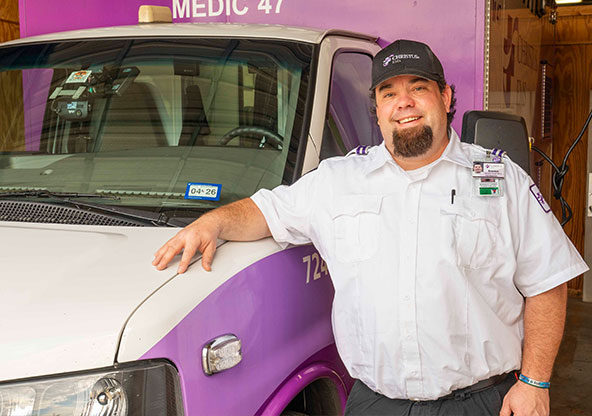
Bucking the Paramedic Trend
Paramedics are in high demand and hard to keep.
Brandon’s decision to make it his long term profession bucks a national pattern of turnover and burnout, pointing to a deeper story about purpose, support, and culture in the field.
Recent surveys show that turnover among full time paramedics can reach 26–27% percent per year. This means many services replace a large portion of their staff every few years, with burnout and workforce stress playing a major role.
At CHRISTUS Health, the annual turnover rate for paramedics is 11%, setting a different standard in a field known for constant change.
At the same time, the occupational outlook for EMTs and paramedics shows steady growth. Employment in the field is projected to increase about 5% from 2024 to 2034, slightly faster than the average for all jobs, according to the U.S. Bureau of Labor Statistics.
So Why did Brandon Stay?
For Brandon, staying wasn’t about endurance. It was about support, especially at the moments when leaving would have made the most sense.
That pattern isn’t accidental, according to CHRISTUS EMS Shift Commander, Les Bentley, a longtime paramedic and supervisor who has spent more than three decades in emergency care.
“People don’t leave because the job gets hard,” Les said. “They leave because they feel like they’re carrying it alone.”
Early in Brandon's career, life made things complicated.
As an EMT, he was married and raising a newborn who spent time in the NICU. Continuing school on his own wasn’t realistic.
Instead of forcing a choice between family and growth, CHRISTUS Health offered an in-house paramedic program that allowed Brandon to advance while continuing to work his shifts. and without taking on additional financial burden.
“I’ve been really blessed,” Brandon said. “We’ve had really good mentors from the top down.”
Those mentors didn’t pressure him to move faster than he was ready or push him out of the role he loved. Instead, they did something more sustainable: they asked what he wanted next, made opportunities visible, and stepped in when he needed support.
That support mattered most during the most challenging periods of the job.
Emergency medicine has a well-documented burnout curve, and Brandon felt it too.
Years of difficult calls accumulated quietly until a mentor noticed the signs before Brandon did himself.
He was pulled off the truck, his schedule was cleared, and he was encouraged to take time away and use available mental health resources.
“That decision probably saved my career,” Brandon said.
Les said that kind of intervention is intentional.
“Burnout doesn’t usually show up all at once,” he said. “It stacks. If leaders aren’t paying attention, they miss it. If they are, they can save careers.”
Practicing Medicine as a Paramedic
Just as important as the support system was the way Brandon was allowed to practice medicine.
At CHRISTUS, paramedics work under assessment-based guidelines rather than rigid, one-size-fits-all protocols.
Les says that autonomy is one of the biggest reasons experienced paramedics stay.
“When you trust people to think, assess, and make decisions, they stay engaged,” he said. “When everything is scripted, they burn out faster.”
That autonomy gave Brandon space to think, listen, and respond to what each situation required, not just what a checklist dictated.
“It allows empathy to show through,” he said. “You’re treating the person, not just the symptoms.”
That approach shaped how he handled everything from high-acuity emergencies to quiet moments spent sitting with patients who were afraid, anxious, or nearing the end of life.
One recent call, helping a hospice patient experiencing severe bleeding, reminded him why he still clocks in after all these years.
“We didn’t rush her. We stayed. We listened,” he said. “That call reminded me why I do this.”
Leadership Played a Role, Too.
Les describes Brandon as the kind of clinician who seeks guidance and uses it in how he leads, teaches, and interacts with others.
“You tell him something once, and it sticks,” Les said. “Then he makes it better.”
Today, Brandon mentors others the same way he was mentored: steadily, honestly, and focused on helping people succeed in a demanding profession.